Flipkart - Search Bar

Monday, December 09, 2013

Book Review : ‘The Winds of Hastinapur’ by Sharath Komarraju


Frankly speaking, I do not know of my opinion of this book, ‘The Winds of Hastinapur’. So, I guess I’ll leave that to you, folks...

Sharath Komarraju’s book is divided into two parts, ‘River Maiden’ and ‘Fisher Girl’. Yet, it is not either of their books; it is Devavrta’s or perhaps, Bhishma’s.

‘River Maiden’ reads like a fantasy tale. From the beginnings of the river Ganga, when she is known as Jahnavi to her transformation to Ganga, the Lady of the River. We are quietly told the story albeit, a little differently. 

It is not like any tale, it is not meant to be written and understood. But, it is meant to be only heard, and quietly taken in. The first part, that is. The second part, on the other hand can be read and understood.

Ganga is but a maiden, when she is told of a terrible curse, which did not involve her at all. But she is unfortunately, a part of it. Not just any part, but she is the carver of it. She finds herself in Hastinapur and with its king, Shantanu with whom she is destined to be married to. The king soon falls in love and promises to keep her,  provided she gives him the son, she had promised. What she has to go through, before she finally hands him over, forms this episode.

Devavrata is the eighth son born to Ganga and Shantanu. His growing up, which happens in Meru with the Celestials and his coming out as a man, that happens at Brihaspati’s ashram are all in the first part. About what the Crystal Lake contains and how salt is created are parts, which could have been excellent, but instead become a tad confusing.

This first part ends with Devavrata leaving Meru behind to find his father, because Hastina on earth, is where he is destined to be.

The second part opens with the entrance of Kali. Kali, as Satyavati was known at the start was a fisher girl. She is meant to lay with Parashara, have his son and not know him. How she manages to get out of her little fishing settlement to become the second wife of Shantanu forms this part.

Her life with him, her destiny, her ways of destroying Devavarta’s so-called destiny, her two sons, and finally her tryst with her first son, lead towards this pre-Mahabharata phase. 

The second part, though written by the same author, does not look it. It seems like this entire portion of the story, is far from the fantastical parts (River Maiden)of this book. I did not like the first part, but I did like the fisher girl’s version in the second part.

P.S. Would have loved to know why and how the characters got their names.  I do have to say though, of the weird bold text used in the book. Also,the capital letters whenever there is talk of somebody or something important, was terribly distracting. But, one does get over it...
Author: Sharath Komarraju 
Publisher: HarperCollins Publishers India
ISBN  978-93-5116-087-8
Price: India:  Rs 299

Friday, December 06, 2013

Author Interview : Sadiqa Peerbhoy, author of 'Marry Go Round'


Hyderabad always had this weird feeling for me. Though, I have always felt at home, it also spoke to me perhaps due to its laid back attitude, its laziness, and of course, the feeling of Saturdays.

Well, it was good to know that I wasn't the only one with this feeling. Sadiqa Peerbhoy, the author of this book, 'Marry Go Round' took it a step further... Here she talks of the city's contasts and its own marital drama, and Enid Blyton, to go with it.  Here, she adds more to my MGR's review.

Feels like quite tho good ol' Hyderabadi menu, stacked with all its spices...

How did ‘Marry Go Round’ happen? 

I quit my high stress adverting job and allied fields and gave myself three months to get the book out. I had earlier written two. 

One, a book of short stories and another, compilation of my columns from the newspapers. ‘Marry Go Round’ (MGR) is my first full length book.

Hyderabad is the place, which has been the basis for your book. What all were inspirations in the city?

My parents come from Hyderabad, and I am familiar with the milieu. The contrasts in the city fascinate me.

It is a very interesting mix of old values and modern lifestyle. Its people are very inspiring in their warmth and simplicity. And the hankering for drama in their lives was all inspirations in their own way.

Marriage is a universal topic. How did you come up with the core idea and develop it? 

I think it's universal for parents of a certain age to want their kids to settle down and procreate. More so, if they are obsessed with perpetuating their lineage.

That is why the mother is obsessed with Riaz getting married and having a child from the right kind of girl.

How would you relate the book and its characters to the lives today? Any similarities?

MGR and its characters are very credible in the present day Hyderabad, where the clash of old values and new beliefs are of heard in every home.

Who was it that told you that you could become the author, you are today?

I wanted to be a writer since I was five years old and discovered Enid Blyton!

Any advice to writers that would like to be published today? How tough is it to be published in India?

That is the toughest part till you make a name for yourself. Most publishers do not even reply for 6-8 months leaving you in limbo.

I would advise authors to write, what is commercially viable by checking out the current best sellers.

Who are your favourite authors?

Too many among Indian writers, I like Amitav Ghosh and Anuja Chauhan.

Which book are you currently reading?

‘The Hope Factory’ by Lavanya Shankaran and ‘Between the Lines’ by Jodi Picoult.

What book is coming from your desk, next? When do you see it released?

It is named ‘The Ghost of Barron House’, and it should be out in 2014.

What else do you like to do on a daily basis?

I write for about three hours, and then I read or watch TV. Twice a week, I go for Hindustani music classes.

Wednesday, December 04, 2013

Editor Interview: Reena Puri, Comic Book Editor, Amar Chitra Katha


Folks, we begin our Publishing Interviews, today. We’ll talk to editors, and try and find out the process of publishing. What all it entails, and as writers what we all need to do to help make it a smoother process.

So, we are starting off with Amar Chitra Katha comic book editor, Reena Puri. She talks to us about what an ideal writer would be like and how she would look at a comic book.  And the tips she would give to us, aspiring writers…

 So, Read on Folks and find out more…


What are you looking for in a comic book?

A story well told. Reading made easy. Interesting visuals and layouts.  In an Amar Chitra Katha, I look for Indian relevance apart from the above three.

What are the qualities of an ideal writer?

If you mean a writer of comic scripts then it is the ability to see the story in visuals rather than in words and be able to use words only to push the story forward. This needs tremendous skill and control over language. More importantly, the writer should be a natural storyteller who thinks in sounds and expressions.

Could you explain the process, from writing, drawing to editing, and finally, printing?

The process of creating a title starts with research. The source of every story has to be identified and authenticated. Backgrounds studied, interviews held and pictorial references acquired. Very often, the writer has to travel to different locations to study a subject or meet people. 

For example, while researching Mother Teresa, our writer volunteered with the Missionaries of Charity in Kolkata to get a first-hand feel of the work being done, and also to talk to the people who had worked with Mother.

Then, a synopsis is written which outlines the plot for the 30 odd pages that the comic is comprised of. Once that is approved the script is written in the comics format. A script could require to be worked upon a couple of times during the editing process.
 
The final script with all the visuals and references in place is then given to the artist. The pages are first pencilled and sent to the editorial to be checked against the script. Most of the corrections are done at this stage.

The pages are then inked and sent to the colourist. After the colour comes the setting of the text, the proofing, colour and text corrections and finally, the comic is ready to go to print.

What sorts of project(s) are most likely to get an okay from you?

A good story, an inspiring person, a forgotten part of history, literature that tells the story of our country and folklore that could teach good principles and values.

What are your top three favourite books?

The Illiad, The Mahabharata, Alice in Wonderland (among many others – three is too small a number!)

Which are the favourite comic books?

The Phantom, The Beano and of course, ACK.

Could you tell us about some of your upcoming titles? 

We are working on a number of projects but the one we are busy with at the moment is Ayodhya Kand from the Ramayana.

What is your favourite thing about being an editor? And your least favourite thing?

Most favourite - Being the Associate Editor of Tinkle for many years and now of Amar Chitra Katha, I live in a world of stories, vivid pictures and brilliant colours.
My work has never felt boring or tedious. Each day is more exciting than the last.

Least favourite - Missing deadlines.

What is the one thing, you would you tell an aspiring writer? (feel free to include as many tips as you would like)

Try and write every day. Even if it is a paragraph, writing skills like music need to be honed and perfected. And nothing is more valuable than practice.

Start by writing about what you are most familiar with.

You must love the language that you choose to write in. It is only when both of you are comfortable with each other that you can use it to give shape to your thoughts, and it will come forward and give you the words that you need to express those thoughts.

And then, the acid test that my founder editor, Anant Pai, taught me – After you have written, catch hold of someone (in my case, it was a child just rushing out at playtime!) who is busy doing something and read out your piece to them. The response will give you a feedback about your work.

Did you always know that you wanted to be a children’s book editor? 

I wanted to write for children and I still do. Some of that, I realised while working as Associate Editor of Tinkle. But now all my time is taken up in editing and coordinating. I hope I will be able to write again someday.

Monday, December 02, 2013

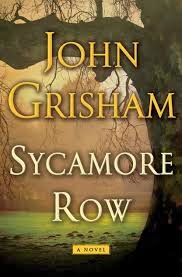
Book Review : 'Sycamore Row' by John Grisham


Is he back? John Grisham, one of my favourite authors, since the day I had wanted
to become a lawyer (but didn’t, thank everyone) seemed to be back in fine form. I was thinking it would be a run of the mill book, but then, I saw Jake Brigance. Brigance was the person, who literally set my eyes on the profession of law. He was not just any lawyer, but The Lawyer.

It is three years since the Carl Lee Hailey case, and the Klu Klux Klan’s ghost is still causing Jake to look over his shoulder. Since he won the case, he won rave reviews, specifically from the black people of fictional town, Clanton, Mississippi. 

But, the poor man remained poor despite the near celeb status, the case had. Still the struggling lawyer, he was three years back, with a wife and kid in tow. Jake receives a letter, which has money written all over it. This, from Seth Hubbard who sends a letter and a will, instructing him to defend it. As per the will, Hubbard gives most of his money to Lettie Lang, his black housekeeper. Hubbard sends these instructions to Jake, before taking his own life. He manages to exclude both his children in the process.

One of the other nominees for the will include his brother, Ancil.

He knew it would create quite the row in his town. A white man giving away most of his hard earned money to a black woman, who has a son in jail, a daughter in the army, another one with two illegitimate kids, an old mother, and an abusive husband.

Grisham definitely had his sense of humour intact, as he wrote this one. Read the funeral instructions for a taste of it. The story led on to the court, where we are met with the humourless judge, more lawyers, because Hubbard’s kids are not going to take this lying down. There is also Lang’s unfortunate lawyer, who was only the icing. 

Grisham’s characters seem to take precedence over the story. Too many of them. Very tiring and confusing, as they just add pages to the story, but offer no real value. Must mention Rufus Bailey, his arrival is almost cinematic.

There is some interesting black family history, which eventually takes the case. Ancil Hubbard, who remains in the background, is almost back with a bang towards the end.

Read the book, because it just might be Grisham’s comeback, since I haven’t seen anything as good since his non-fiction, ‘The Innocent Man’. Also, if you want to notice the similarities to Harper Lee,’s classic ‘To Kill a Mockingbird’. Of course, ‘A Time to Kill’ is more in line with it but the great black/white divide seems eternal. Also, Jake Brigance was the lead in the first book, but in this sequel he seems lost among all the characters.

‘SycamoreRow’ seemed to begin brilliantly at word go but lost its way in the middle, only to find itself in the end. It gave me Goosebumps, like the first time I read ‘A Time to Kill’. It is definitely worth a read.

Note on Cover :  Quite nice, though I do like the picture above better. 

Author: John Grisham
ISBN 978-1-444-77955-4